

Illuminations, p.1
Illuminations, page 1


PRAISE FOR T. KINGFISHER
"Dive in...if you are looking to be charmed and delighted."”
LOCUS
“…[A] knack for creating colorful, instantly memorable characters, and inhuman creatures capable of inspiring awe and wonder.”
NPR BOOKS
"The writing. It is superb. T. Kingfisher, where have you been all my life?"
THE BOOK SMUGGLERS
“…you walk away going ‘Damn, that was good but there's a new layer of trauma living inside me.’”
KB SPANGLER, DIGITAL DIVIDE
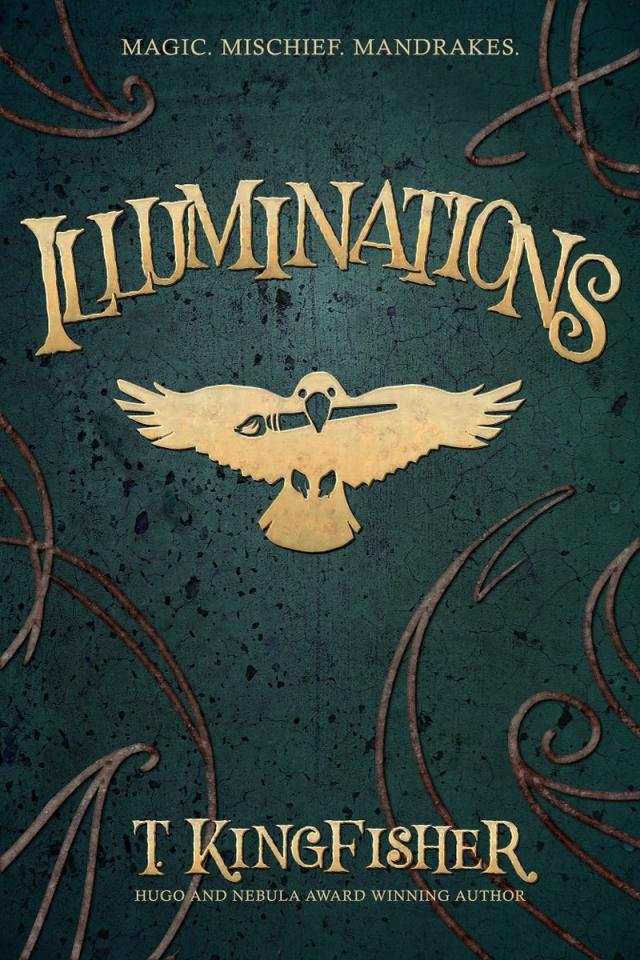
ILLUMINATIONS
T. KINGFISHER
Copyright © 2022 by T. Kingfisher
Ebook by Red Wombat Studio
All rights reserved.
No part of this book may be reproduced in any form or by any electronic or mechanical means, including information storage and retrieval systems, without written permission from the author, except for the use of brief quotations in a book review.
Created with Vellum
CONTENTS
Chapter 1
Chapter 2
Chapter 3
Chapter 4
Chapter 5
Chapter 6
Chapter 7
Chapter 8
Chapter 9
Chapter 10
Chapter 11
Chapter 12
Chapter 13
Chapter 14
Chapter 15
Chapter 16
Chapter 17
Chapter 18
Chapter 19
Chapter 20
Chapter 21
Chapter 22
Chapter 23
Chapter 24
Chapter 25
Chapter 26
Chapter 27
Chapter 28
Chapter 29
Chapter 30
Chapter 31
Chapter 32
Chapter 33
Chapter 34
Chapter 35
Chapter 36
Chapter 37
Acknowledgments
About the Author
Also by T. Kingfisher
ONE
Morning
Garlic Day
Messidor, the Month of Harvest
* * *
Once upon a time, there was a girl named Rosa. She had black hair and brown skin and brown eyes and she was a little bit plump and her favorite color was purple and she was deeply, profoundly, exquisitely bored.
“I am more bored than anyone has ever been in the history of the world,” she said, lying on her back on her bed and staring at the distant ceiling. “However bored anyone has ever been, I am a hundred times more bored than that.”
She was talking out loud to a painting. The painting didn’t say anything, but then, Rosa didn’t expect it to. It was not a very good painting, but Rosa was not a very good painter. At least, not yet.
She lived in the world-famous Studio Mandolini, home to the Mandolini family, the greatest painters of magical illuminations in the city. If you wanted a magical illumination—a painting that would carry a magical charm—you went to the Studio Mandolini and told them what you wanted, and they would paint it.
Rosa was extremely proud of her family, even if they weren’t doing anything to stop her from dying of boredom.
The Mandolinis painted pictures of radishes with wings to ward off sickness, and they painted great droopy-faced hounds with halos to protect against burglars. They painted flaming swords on shingles to keep storms from blowing the roofs off houses, and they painted very strange pictures of men with hummingbird heads to keep venomous snakes out of people’s gardens.
And every one of these paintings worked, although they would wear out over time. Sometimes the illumination had to be very large. It was no good getting a tiny painting of a blue-eyed cat to keep mice away if you had a barn that was already full of rats. The tiny painting would keep mice out of your pantry, but to keep them out of a barn, you needed a painting six feet high with a blue-eyed cat the size of a tiger.
It could be any sort of cat in any kind of position, but it had to have blue eyes. Illuminations were very specific that way. It didn’t matter if your favorite color was purple—if you snuck into the pantry and painted the cat’s eyes purple, it would stop working and mice would come in and dance all over the cheese.
(Rosa had been very young when she gave the cat in the pantry purple eyes, and her grandmother had forgiven her for it, even though they had to throw out all the cheese.)
She was five years older now—ten, nearly eleven, and a great deal wiser than when she was five, nearly six. She understood all about illuminations and how you never ever changed them. And that was the problem.
It was very boring, when you wanted to draw, to always have to draw the same things the same way. Maybe you didn’t want the man to have a hummingbird’s head. Maybe you wanted him to have a crocodile’s head so he could open his mouth very wide and swallow up your chores.
Maybe you wanted the cats to have purple eyes, or green eyes, or one green eye and one purple eye.
Maybe you wanted to paint radishes with teeth instead of wings.
The problem was that if you painted it that way, the magic wouldn’t work. And the Studio Mandolini was famous for the fact that their illuminations always worked.
Rosa loved her two uncles and her aunt and her cousin and her grandmother, who made up the Studio Mandolini. She loved them all very much and they had taken very good care of her. Her parents had died so long ago that Rosa could barely remember them, but her family at the Studio Mandolini was wonderful.
They did not always understand about Rosa’s paintings, though.
“That’s very interesting,” said Uncle Marco, when she showed him her radish with teeth. “But isn’t it supposed to have wings?”
“Needs wings,” said her Cousin Sergio, who talked in very short sentences, as if he was afraid he would run out of words. He was only twenty-five, but he was already losing his hair. “Won’t sell. No wings.”
“Interesting modern primitivist technique,” said her Aunt Nadia, who was very thin and wore black and talked about art history a lot. “I see what you’re trying to do, subverting the very nature of illumination making. But I don’t think the art world is ready, Rosa. You are too far ahead of your time.”
Rosa didn’t want to be ahead of her time. She wanted to be an illumination painter. But the radishes didn’t do anything. She could feel that there was something to them—something that was almost magic, but not quite—but that didn’t matter. People wanted the real thing.
“It’s lovely,” said Uncle Alfonso. “It’s art, that’s what it is. Not stuffy illuminations. That’s a different sort of magic.” And he took a pin and put Rosa’s radish up on the wall of his studio, where he put all the things that interested him, like drawings of hands and woodpecker feathers and an empty turtle shell and oak leaves with big spotted puffballs on them.
Uncle Alfonso was her very favorite relative. He was actually a great uncle, or an uncle once removed. Rosa wasn’t quite sure how it worked. (He was also even older than Grandmama, because people had very big families in those days and Grandmama’s brother had started having children before Grandmama’s mother had quite finished, so Uncle Alfonso had been born six months before his own aunt.)
Uncle Alfonso always called her “Rosalita” which meant “little rose” and no one was allowed to call her that but him.
Even if they didn’t always understand about her radishes, her family was very nice. Dinner time was always loud and everyone laughed a great deal and told stories and jokes and no one was allowed to talk about sad things because, as Grandmama said, it would upset the digestion. There was actually an illumination painted on the table, of two peppermills crossed like swords, to prevent indigestion and queasiness and upset stomach, but Grandmama Mandolini did not believe in taking chances.
She loved her family, and she could not imagine living anywhere other than the Studio Mandolini.
But her family was also very busy, because they were the very best in the world, and so when Rosa was bored, she had to find ways to entertain herself.
TWO
The Studio Mandolini was very tall and had windows all the way up to the ceiling, to let in the light that was so essential for painting. The ground floor was cut up into little rooms, called “bays,” but none of the bays had ceilings. Everyone had their own walls and their own personal workspace and a bedroom behind the workspace, up against the wall.
Rosa had slept for a long time on the couch in Grandmama’s room, but when she turned nine, she was given her very own bay in the studio. It was a little bit bare, because everyone else had big stacks of canvases and wooden boards to paint on, and Rosa had only a pad of paper and a pencil and lots of drawings of radishes, but it was her very own. Uncle Alfonso had given her an interesting owl feather, which she had tacked up on the wall next to her very best radish drawing. Aunt Nadia had painted an illumination to ward away nightmares, of a cheerful little pig surrounded by flames. (The flames did not seem to be bothering the pig at all.) Rosa put it up over her bed and whenever she did not have a nightmare, she thought very kindly of Aunt Nadia.
It was not quite perfect. At night, she could hear Cousin Sergio snoring in his bay next to hers, and sometimes, when his allergies were bothering him, Uncle Alfonso would snore too and Rosa would have to put a pillow over her head to drown them all out. Usually, though, it was pretty good.
But not today. Today, rain was coming dow n gray and drizzly against the enormous studio windows and Rosa was as bored as she had ever been in her life.
She had drawn radishes until she was tired of them. Some had teeth and some had claws and some breathed fire, but none of them had wings.
She had read all her books, several times over.
She had tried to write a story, but she couldn’t think of what the story should be about, so she added in a monster to come and eat the hero. She wrote “The End” and signed her name, but while this was somewhat satisfying, it was also only six lines long and she still had the rest of the afternoon left to go.
“I’m bored,” she told Cousin Sergio.
“Can’t talk!” he said. “Painting! Nearly done!”
“I’m bored,” she told Uncle Marco.
“Hmm,” said Uncle Marco. “Interesting.”
“No,” said Rosa. “It’s not. If it were interesting, I wouldn’t be bored. Being bored is the opposite of interesting.”
Uncle Marco pushed his glasses up on his nose. “You could go play outside.”
“It’s raining.”
“Rain is very interesting.”
Rosa gave up and went to the next bay.
She gave Aunt Nadia’s studio a very wide berth because Aunt Nadia was doing a big painting for the Merchant’s Guild, which required eleven angels holding various objects, and which was supposed to ward off bribery and corruption and also termites. Aunt Nadia liked to work from live models if she could, and if Rosa went into the studio, she would undoubtedly be dressed up in angel robes and told to hold very still.
Rosa didn’t mind modeling for paintings. She had done it lots of times. There was an illumination on the wall of the grocery to keep food from spoiling that was actually a painting of Rosa as a baby. Rosa always felt smug when she went into the grocery and saw it there.
Sitting still for hours was surprisingly hard, though. You started to get stiff in muscles that you didn’t even know existed. You got breaks every few minutes, but the rest of the time you had to sit absolutely still and not whine and not fidget. If you moved even a little, the artist had to either change the painting or rush over and move you back to the way you had been and it was all a great deal more difficult than anyone who hadn’t done it would think.
So she snuck past Aunt Nadia’s bay, feeling just a tiny bit guilty.
Uncle Alfonso had gone out to buy paint, and that left only Grandmama Mandolini.
Grandmama was bent over a ledger, making sure that the studio accounts balanced. It was not the sort of thing that a ten-year-old could help with, even if she was nearly eleven.
“I’m boooooorrred,” announced Rosa.
“Go play with Serena,” said Grandmama, not taking her eyes off the ledger.
Rosa scowled. “I don’t always like Serena,” she said.
“Nonsense,” said Grandmama. “You’re best friends, or you were last week. Go play.”
Rosa heaved a great sigh, but there was no arguing with that tone of voice. She put on her shoes and picked up an umbrella and went to go play with Serena.
Serena lived three blocks away, on the main street, instead of at the end of a higgledy-piggledy alleyway. Her family were illumination painters too, but not as talented or as famous as Studio Mandolini.
Rosa had been telling the exact truth when she said that she didn’t always like Serena. She wasn’t entirely sure that she liked her right now, but at least walking to Serena’s house would give her something to do.
Serena was a year and a bit older and had just turned twelve. They had been thrown together for years, because even very sensible grown-ups seem to believe that children will be friends simply because they are the same age.
When they had been younger, they would play together, and Serena would always say, “You have to do what I say, because I’m older!”
It was some years before Rosa realized that Serena would always be older, and there was never going to be a time when they did what Rosa wanted. This seemed very unfair.
(“Life isn’t fair,” Aunt Nadia said, when Rosa told her this. “But she’ll probably die first, being older, so it works out.” This was not the sort of comfort that Rosa was looking for. Aunt Nadia was bad with children, and even worse with adults.)
When they were young, they had pretended to be horses, which was fine, or Great Beauties, which was…less fine. You could usually insert a monster into a story about horses, but not one about Great Beauties.
“We’ll be Great Beauties, “said Serena. “We’ll take the town by storm and go to the opera and the theater and everyone will be dying to be seen with us. And I’m the prettiest.”
“Then I’m the smartest,” said Rosa.
“Then I’m the most fashionable,” said Serena.
“And I’m the bravest,” said Rosa.
Serena scowled. “You don’t need to be bravest,” she said.
“What if there are monsters?”
“There aren’t any monsters in this story.”
“There could be a little monster?” said Rosa hopefully. “At the opera, maybe? It could come into our box at the opera and you can swoon very prettily and people will fan you and bring you lemon ices and I will kick the monster in the head with my boots.”
“Great Beauties don’t wear boots to the opera,” said Serena darkly.
“I’m not the fashionable one,” said Rosa. “So I’ve got boots.”
“You’re such a child,” said Serena, and refused to play anymore.
It didn’t help that Serena was very pretty, with deep amber skin and hair like black silk, and that she was already nearly four inches taller than Rosa.
Lately Serena had stopped saying, “You have to do what I say!” and had started rolling her eyes and saying, “You’ll understand when you’re older,” as if an extra year was a brick wall thirty feet high and Rosa was on the wrong side of it. And she frequently didn’t want to play any games at all, but instead wanted to talk about boys that she thought were handsome. Rosa was skeptical of this, because Uncle Marco said that beautiful people were boring to paint and that normal people, who had bumps and wrinkles and folds, were much more interesting. Being interesting seemed like a much better deal than being handsome, but that only made Serena roll her eyes harder.
But despite all this, sometimes they were still friends, and Serena and Rosa would lay on the floor of Serena’s bedroom and draw pictures. Serena drew horses and unicorns and gryphons and Rosa drew horses and monsters and fanged radishes. Those were pretty good times. Serena’s horses were better—Rosa had a hard time getting the hind legs right—but Rosa’s monsters were bigger and had more teeth and fangs and eyeballs and whiskers.
And they never argued about the future—the real future, not the pretend one where they were beauties and the toast of the town. The real future, they both knew, was that they would learn the family trade and become illuminators and spend their lives painting in the studios where they had grown up.
THREE
Afternoon
Garlic Day
Messidor, the Month of Harvest
* * *
Rosa turned down the street where Serena lived. You could see her family’s studio right away, because it had a portico, like an archway with columns. You couldn’t possibly miss it.
There were gold letters over the grand portico, proclaiming it the home of the Studio Magnifico. Rosa ignored it and went to the smaller entrance next door. Serena’s family didn’t sleep in their studios the way that Rosa’s did. They had ordinary bedrooms and weren’t surrounded by canvases all the time.






